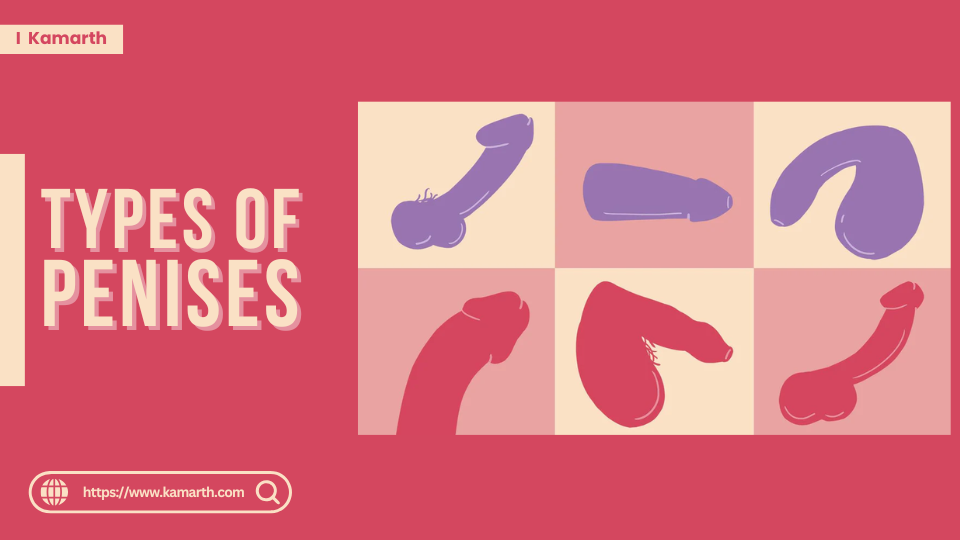
Types of Penises – You might think that all men’s penises are the same, but that’s completely wrong. Just as every part of the body is different, men’s penises vary greatly in length, girth, or curvature.
In today’s article, we’ll discuss common penis types, the differences in their shapes and sizes, and some important facts you should know.
Table of Contents
What is Penis?
The penis is a male organ that is essential not only for reproduction but also for urination. It has two main parts: the shaft, which connects the penis to the abdomen, and the head, which is the tip of the penis.
Every man’s penis is unique, and its size, shape, and appearance vary considerably. Now, let’s discuss this in detail. First, let’s talk about penis length, as this is the aspect that often arouses the most curiosity and concern in people.
Read Also: Endometriosis: Stages, Causes, Symptoms, Diagnosis
Length of Penises
The length of the penis varies between the flaccid and erect states. In the flaccid state, the penis appears shorter, and in the erect state, it becomes longer and may sometimes even appear thicker.
This can also be understood as flaccid, meaning the penis is in a dormant state, and erect, meaning the penis is aroused and ready for sexual intercourse.
According to a 2018 study, approximately 26% of penises are elongate, meaning their length increases significantly when transitioning from a flaccid state to an erect state. Meanwhile, 74% of penises remain unchanged in length when transitioning from a flaccid state to an erect state. Estimates of average penis length vary slightly across studies.
A 2023 systematic review and meta-analysis found that the average erect penis worldwide is 5.5 inches long, and this study also found that the average erect penis length has increased by 24% over the past 29 years.
But sometimes, I have a problem with studies on penis length. Participants often self-report their measurements, and self-reported data can introduce bias. This is why people mistakenly assume the average penis is 6 inches, when in reality, the average size is slightly smaller. It’s important to understand that every penis is different, and not to pay too much attention to numbers.
Read Also: Egg Freezing: Breaking Barriers or Evolution of Family Planning
Girth of Penises
Penis girth also varies from person to person. Some penises are naturally thinner, while others are slightly thicker.
In 2025, a comprehensive systematic review and meta-analysis was published, which included data from 33 studies and 36,883 people. This study found that the average erect penis girth worldwide is approximately 11.91 cm or 4.69 inches. This research was also analyzed by various regions of the World Health Organization.
But, like length studies, girth studies are mostly self-reported, meaning participants report their own measurements. This is why these figures are not always 100% accurate. Every penis has a different size and girth, and this is not necessarily considered normal or abnormal.
Read Also: Ovulation (A Monthly Cycle) – 04 Phases, Timeline, Pain and Essential Symptoms
Curvature of Penises
Every penis can become fully erect when aroused, but many penises naturally have a slight bend and curvature. This is completely normal and generally considered harmless.
Curved penises are found primarily in young men, with some curving upward from the base, some downward, and some to the left or right. Sometimes the penis can bend in multiple directions, such as up and left.
Penis curvature is common and often painless. It usually does not interfere with sexual intercourse. However, if this curvature is severe, it may be a symptom of Peyronie’s disease.
Read Also: Douching (Vaginal Douche): Meaning, Safety, Alternatives & Risks
The Base to Head Ratio of Penises
Every penis is different in size, and there’s an interesting thing called the base-to-head ratio. Some men have the same circumference between the base and the head, which means the entire penis looks relatively similar.
But this isn’t the case everywhere. Some men may have a slightly thicker penis at the base, and some may have a slightly thicker penis at the base. These are natural variations and nothing to worry about. Penis size and shape vary from person to person.
Read Also: Pelvic Inflammatory Disease (PID): Causes, Symptoms & Treatment
Circumcised and Uncircumcised
When every male infant is born, the head of his penis has a thin layer of skin called the foreskin. This skin can be easily pulled back and forth and is a perfectly normal part of the penis. However, some men around the world have their foreskin surgically removed. The process of male circumcision is called circumcision.
It is often performed by a trained physician or medical professional. This procedure is performed for various reasons, such as cultural, religious, or sometimes medical reasons.
When the foreskin is removed, the head of the penis, or glans, is always visible, and such a penis is called a circumcised penis. A penis with a foreskin is called an uncircumcised penis, and this foreskin loosely covers the head of the penis.
In some cases, babies are born without a naturally formed foreskin, a condition called hypospadias. Is the position of the urethra on my penis incorrect, and do I need surgery to correct it?
Read Also: Vaginitis: Types, causes, and treatment
Other Aspects of Appearance
There are many other variations in the appearance of the penis that are completely normal.
- First, let’s talk about hair. Most men have pubic hair around the base of the penis and testicles. Some people also have a little hair on the shaft of the penis, which is completely natural.
- The second aspect is veins. I have some clearly visible veins on my penis. These become more prominent, especially when the penis is aroused. The surface of my penis is relatively smooth, making the veins less visible.
- Now let’s talk about color. Every person’s skin color is different, so the color of their penis also varies. Sometimes the color of the penis is slightly different from the rest of the body, and when blood flow increases during arousal, its color may also change slightly. These are all natural variations, and there’s no need to worry about them.
Read Also: Bacterial vaginosis: Symptoms and Treatment
A note from Kamarth – Types of penises
Friends, there’s a lot of misinformation and myths about the penis floating around the internet. In fact, the penis is unique to each individual, and like any other body part, its length, thickness, and curvature vary. If anyone has any concerns about their penis, they should consult a trained physician.
Read Also: Urinary Track Infection (UTI): Causes, Symptoms & Treatment
Some Additional Doubts
Question: What do normal pennies look like?
Answer:
Question: What is the last age of pennis growth?
Answer:
Question: Is a C-shaped pennis normal?
Answer:
Question: Can pennies get smaller?
Answer:
Question: What to do if penises are not straight?
Answer:
Read More
- Body Image: What is it, and how can I improve it?
- Do You Get Periods in Space? How Astronauts Deal with Menstruation.
- Dyspareunia (painful intercourse): Causes, treatments and more
- Cervical Cap: Contraceptive, How To Use & Effectiveness
- Female Ejaculation – What is it, is it real, and are there
Reference Links
- Can using lube during sex prevent STIs? (n.d.).
- Morris BJ, et al. (2016). Erratum to: Estimation of country-specific and global prevalence of male circumcision.
- Natale CA, et al. (2016). Sex steroids regulate skin pigmentation through nonclassical membrane-bound receptors.
- Sandean DP & Lotfollahzadeh S. (2023). Peyronie disease.
- What’s penis girth worth? (n.d.).
- Yafi FA, et al. (2018). Grower or shower? Predictors of change in penile length from the flaccid to erect state.